← Back to archive
software · 2023

ReLife the Game

A first-person multiplayer sustainability game set in the real city of Alkmaar, built for a real client in Unity and C#.

Context Inholland Hogeschool · Municipality of Alkmaar
Year 2023
Type software

Overview

ReLife is a first-person 3D game where the player works as an agent for POCITYF, a real sustainability initiative, with the goal of making the city of Alkmaar greener.

The game was built as a group project for a real client: the Municipality of Alkmaar. They wanted a game that raised awareness of sustainability and showed how Alkmaar was working toward becoming a Green city, a European model for sustainable urban development. The result is a full game with a progression system, multiple game modes, and randomly generated missions, and support for up to five players.

The Concept

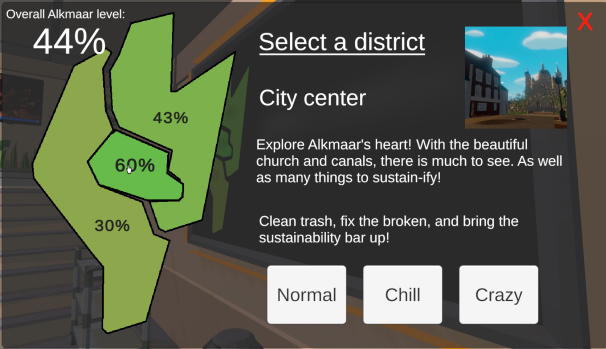
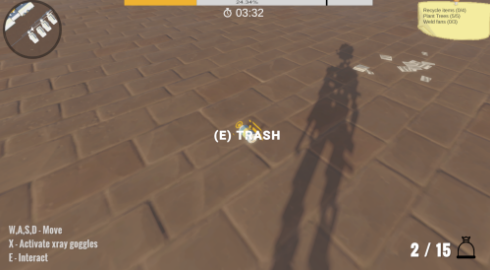
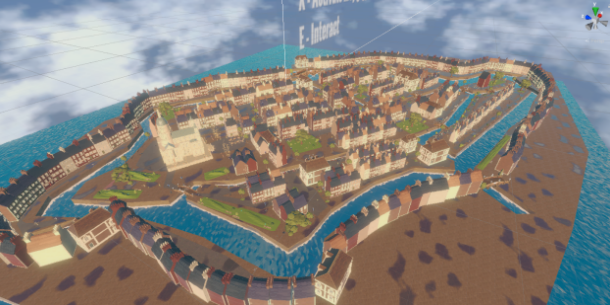
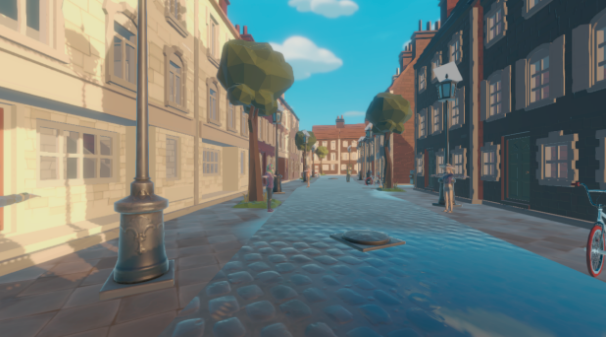
The game takes place across the real districts of Alkmaar. Each district has its own sustainability level, and raising it contributes to the overall sustainability of the whole city. The player explores the district, finds randomly placed tasks, and completes minigames to bring the sustainability percentage up.

The game can be played solo or with up to four other players cooperating on the same map. The lobby is a 3D agent's office where players can view the Alkmaar map, check their stats, and select which district to tackle next.

Game Modes

Normal
A standard timer with the goal of reaching 100% sustainability before time runs out.
Chill
No timer. The player can explore at their own pace and reach 100% sustainability without pressure.
Crazy
A severely reduced timer. The player needs to reach at least 80% sustainability before time runs out, and completing tasks awards bonus time.

Progression

Progression works through two systems running in parallel. Sustainability points track how green Alkmaar is becoming, with the game considered complete when the whole city hits 100%. The system is designed for around 15 hours of playtime on average.

Reputation is the player level, earned through missions. As the player levels up, they unlock new equipment: running boots at level 2, a vacuum at level 3, and X-Ray Goggles at level 4. All equipment is visible from the start so players always know what they're working toward.

At the end of each mission, an End of Day report shows performance stats including distance travelled and most successful minigame.

Tasks and Minigames

Every mission generates a random set of three tasks from the available pool. Tasks are randomly placed across the map to encourage exploration and make each run feel different. Different districts have different tasks: repairing a wind turbine makes sense in a rural area but not in the city centre.

Minigames were designed around three principles: they end quickly so they don't break the game's pacing, they're intuitive to pick up without explanation, and they use simple controls (at most four keys or a mouse click). Difficulty scales dynamically during a mission based on the current sustainability level, keeping the challenge consistent as the player progresses.

After completing each minigame, a popup shares a real sustainability fact related to what the player just did, like how solar street lights can be installed anywhere.

The Minigames

Dig at the Right Moment
A reaction-based minigame where the player plants a tree in three stages: digging, planting seeds, and watering. Each stage requires pressing space at the right moment as a tool passes over the correct spot. Gets faster as difficulty increases.
Clean Sewers
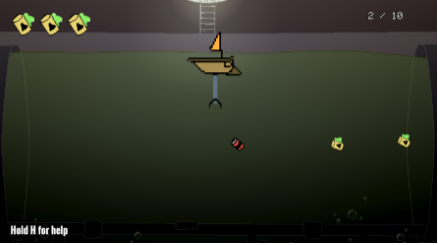
Inspired by gold digger games. The player steers a boat with a hook to fish rubbish out of the sewers before it drifts off screen. Trash spawns faster and moves quicker as difficulty rises.
Rewire
The player rewires a sustainable solar street lamp by connecting colour-matched wires. Completing a connection triggers a particle explosion. The number of wires increases with difficulty, from two up to ten.
Color Beep
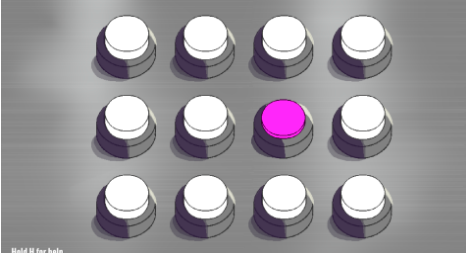
A memory game where buttons flash in a sequence and the player must repeat the order. Fixing a street lamp to run on solar power. The flash speed increases with difficulty.
Fixing Solar Panels
A Tetris-inspired minigame where the player slots falling hardware pieces into place to build solar shingles on buildings. Each completed line contributes to a solar panel image on screen. More lines required as difficulty increases.
Recycle Trash
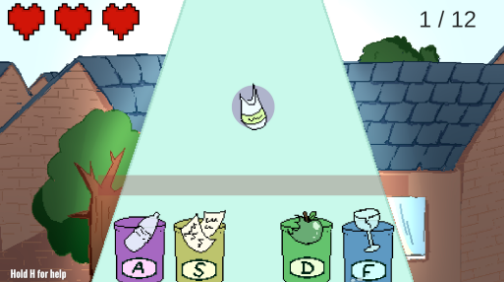
Rubbish falls from the top of the screen and the player sorts it into the correct bin by pressing the matching button at the right moment. Faster and more frequent as difficulty rises.
Wind Turbine Repair
The player guides a blowtorch along a winding path to weld a wind turbine part, staying within the red guide lines. The welding path gets more complex with difficulty. A successful repair shows the turbine fans spinning.

Soft Tasks

Picking Up Trash
Trash is scattered across the city. The player can pick it up with one key press and deposit it in any bin to raise sustainability. Deliberately easy and satisfying so the streets visibly clear as you go.
Flyer Creation and Distribution
In the office, the player creates flyers by matching sustainability facts with the right titles. Handing out pro-sustainability flyers during a mission raises the sustainability bar.

Equipment

Running Boots
Activating the boots gives the player a speed boost for a short period, useful for covering the larger districts quickly.
Vacuum
Automatically sucks up trash around the player and deposits it into the trash bag, removing the need to manually interact with each piece.
X-Ray Goggles
Highlights nearby interactable tasks and trash on the ground. Especially useful in Crazy mode when time is tight and the player can't afford to miss anything.

Built With

Unity C# Multiplayer Game Design Procedural Task Generation Municipality of Alkmaar POCITYF Inholland Hogeschool

Media

ReLife the Game ReLife the Game ReLife the Game ReLife the Game ReLife the Game ReLife the Game ReLife the Game